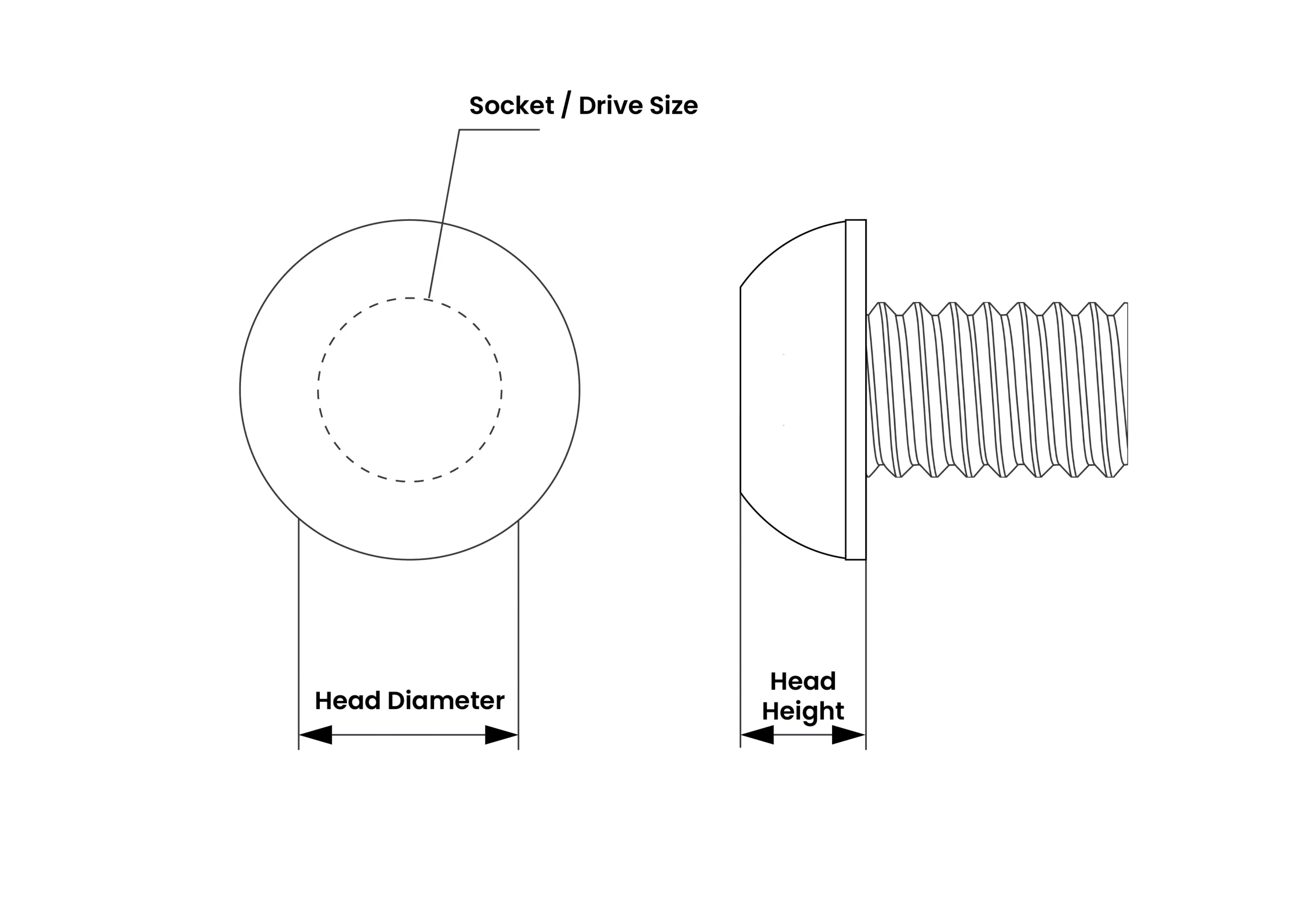
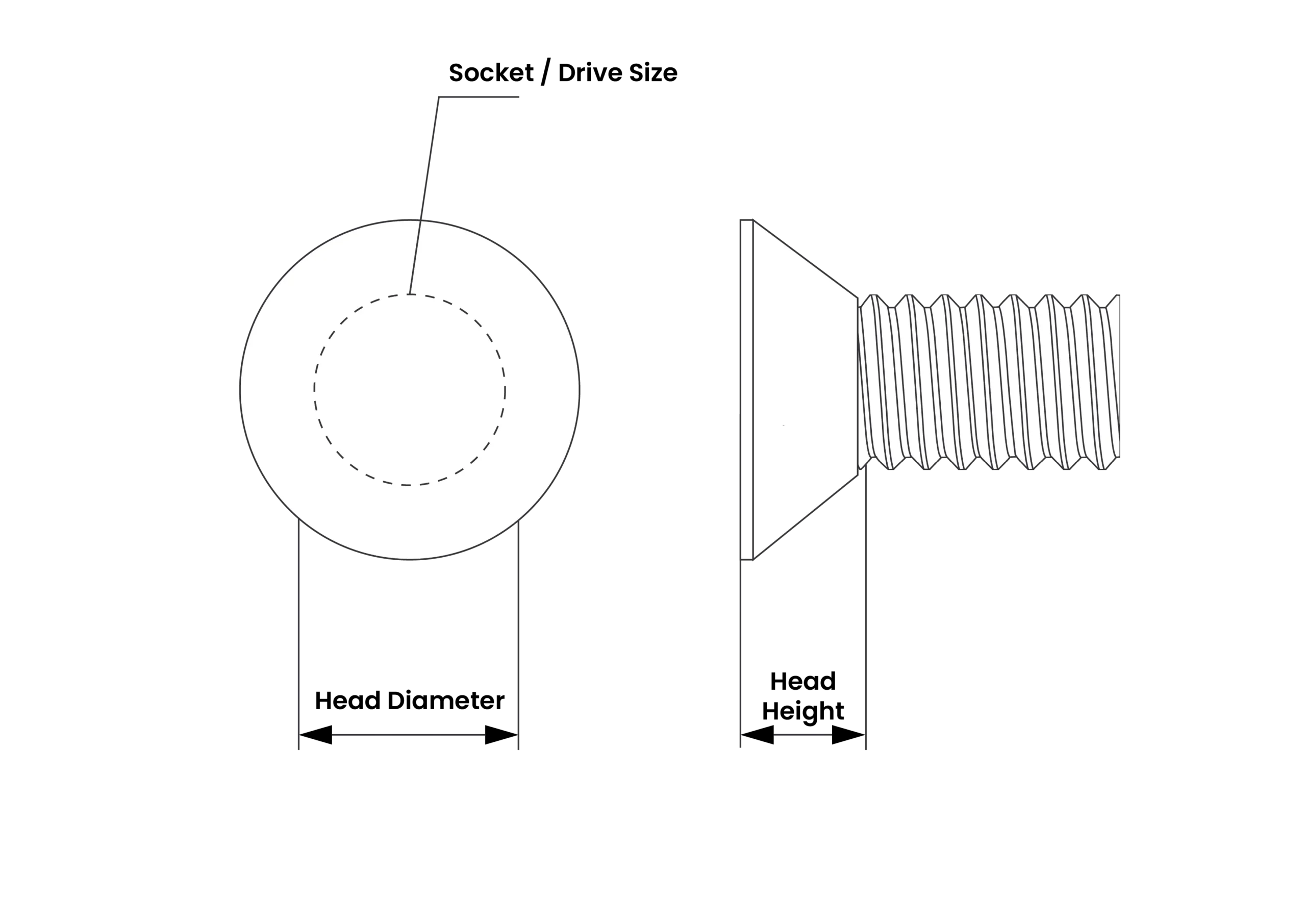
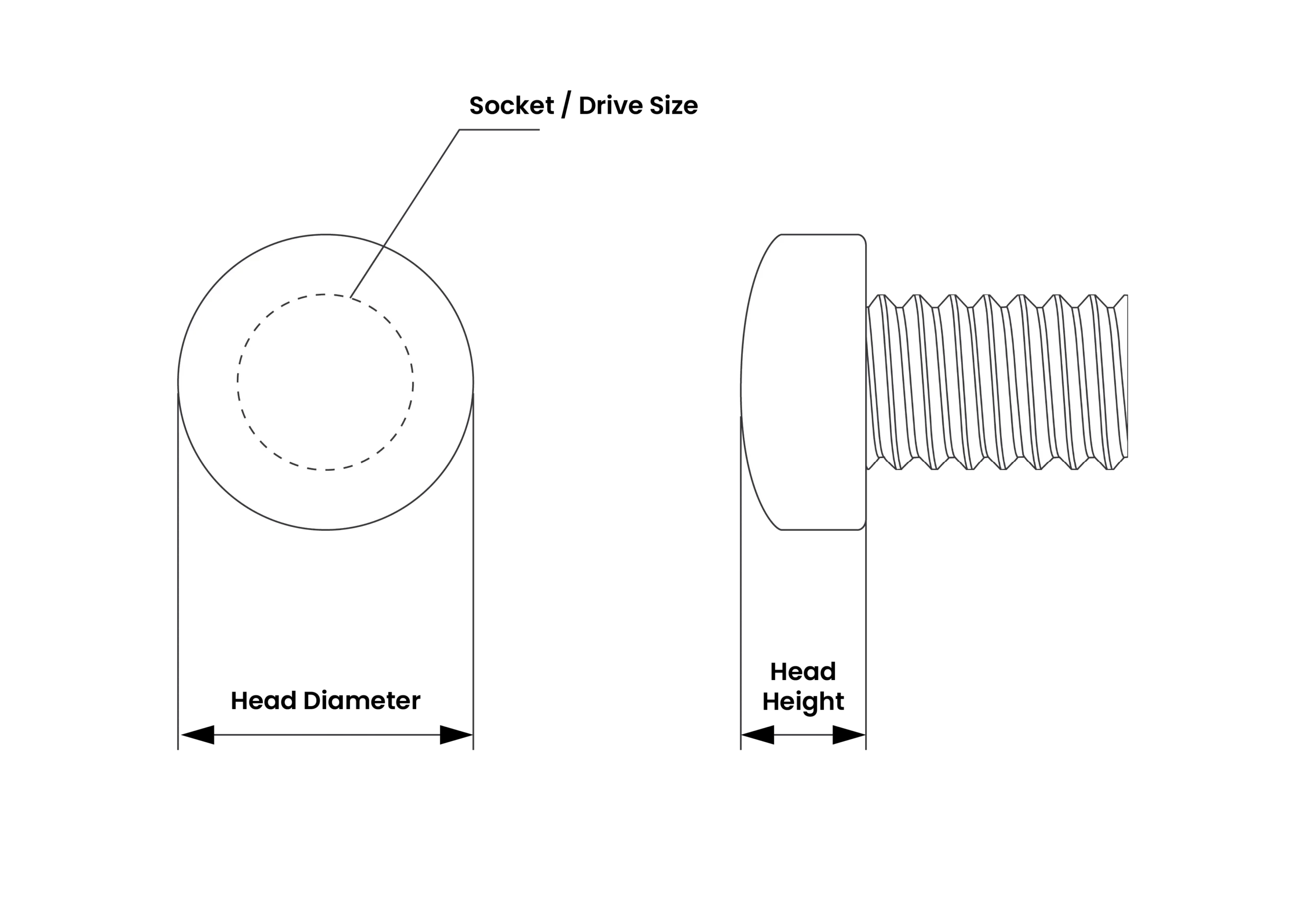
2-1/2” Bolt & Screw Dimensions: Diameter & Head Size
2-1/2″ bolt dimensions and screw sizes are specialized for massive industrial foundations, heavy turbine assemblies, and large-scale civil engineering projects. This size have a 2.500″ nominal major diameter and is available in 2-1/2″-4 coarse (UNC) thread pitch, representing 4 threads per inch (TPI). This reference chart follows ANSI/ASME B18.6.3 and B18.3 standards for the head size and ANSI/ASME B1.1 standards for the thread dimensions to ensure compatibility across extra-large imperial fastening applications.
Disclaimer: Dimensions and tolerances may vary slightly depending on head style, manufacturer, or material — always verify with the official product datasheet before use.
2-1/2-4 UNC Screw & Bolt – ANSI/ASME B1.1
Dimension
Size (in)
Min
Max
Major Diameter
2.4612
2.4969
Pitch Diameter
2.319
2.3345
Minor Diameter
Not specified
2.1992
Threads Per Inch (TPI)
4
Major Diameter
2.4731
2.4969
Pitch Diameter
2.3241
2.3345
Minor Diameter
Not specified
2.1992
Threads Per Inch (TPI)
4
Major Diameter
2.4762
2.5
Pitch Diameter
2.3298
2.3376
Minor Diameter
Not specified
2.2023
Threads Per Inch (TPI)
4
2-1/2-6 UN Screw & Bolt – ANSI/ASME B1.1
Dimension
Size (in)
Min
Max
Major Diameter
2.4791
2.4973
Pitch Diameter
2.38
2.389
Minor Diameter
Not specified
2.2988
Threads Per Inch (TPI)
6
Major Diameter
2.4818
2.5
Pitch Diameter
2.385
2.3917
Minor Diameter
Not specified
2.3015
Threads Per Inch (TPI)
6
2-1/2-8 UN Screw & Bolt – ANSI/ASME B1.1
Dimension
Size (in)
Min
Max
Major Diameter
2.4826
2.4976
Pitch Diameter
2.4082
2.4164
Minor Diameter
Not specified
2.3488
Threads Per Inch (TPI)
8
Major Diameter
2.485
2.5
Pitch Diameter
2.4127
2.4188
Minor Diameter
Not specified
2.3512
Threads Per Inch (TPI)
8
2-1/2-12 UN Screw & Bolt – ANSI/ASME B1.1
Dimension
Size (in)
Min
Max
Major Diameter
2.4867
2.4981
Pitch Diameter
2.4378
2.444
Minor Diameter
Not specified
2.3989
Threads Per Inch (TPI)
12
Major Diameter
2.4886
2.5
Pitch Diameter
2.4413
2.4459
Minor Diameter
Not specified
2.4008
Threads Per Inch (TPI)
12
2-1/2-16 UN Screw & Bolt – ANSI/ASME B1.1
Dimension
Size (in)
Min
Max
Major Diameter
2.4889
2.4983
Pitch Diameter
2.4522
2.4577
Minor Diameter
Not specified
2.4239
Threads Per Inch (TPI)
16
Major Diameter
2.4906
2.5
Pitch Diameter
2.4553
2.4594
Minor Diameter
Not specified
2.4256
Threads Per Inch (TPI)
16
2-1/2-20 UN Screw & Bolt – ANSI/ASME B1.1
Dimension
Size (in)
Min
Max
Major Diameter
2.4904
2.4985
Pitch Diameter
2.4609
2.466
Minor Diameter
Not specified
2.439
Threads Per Inch (TPI)
20
Major Diameter
2.4919
2.5
Pitch Diameter
2.4637
2.4675
Minor Diameter
Not specified
2.4405
Threads Per Inch (TPI)
20
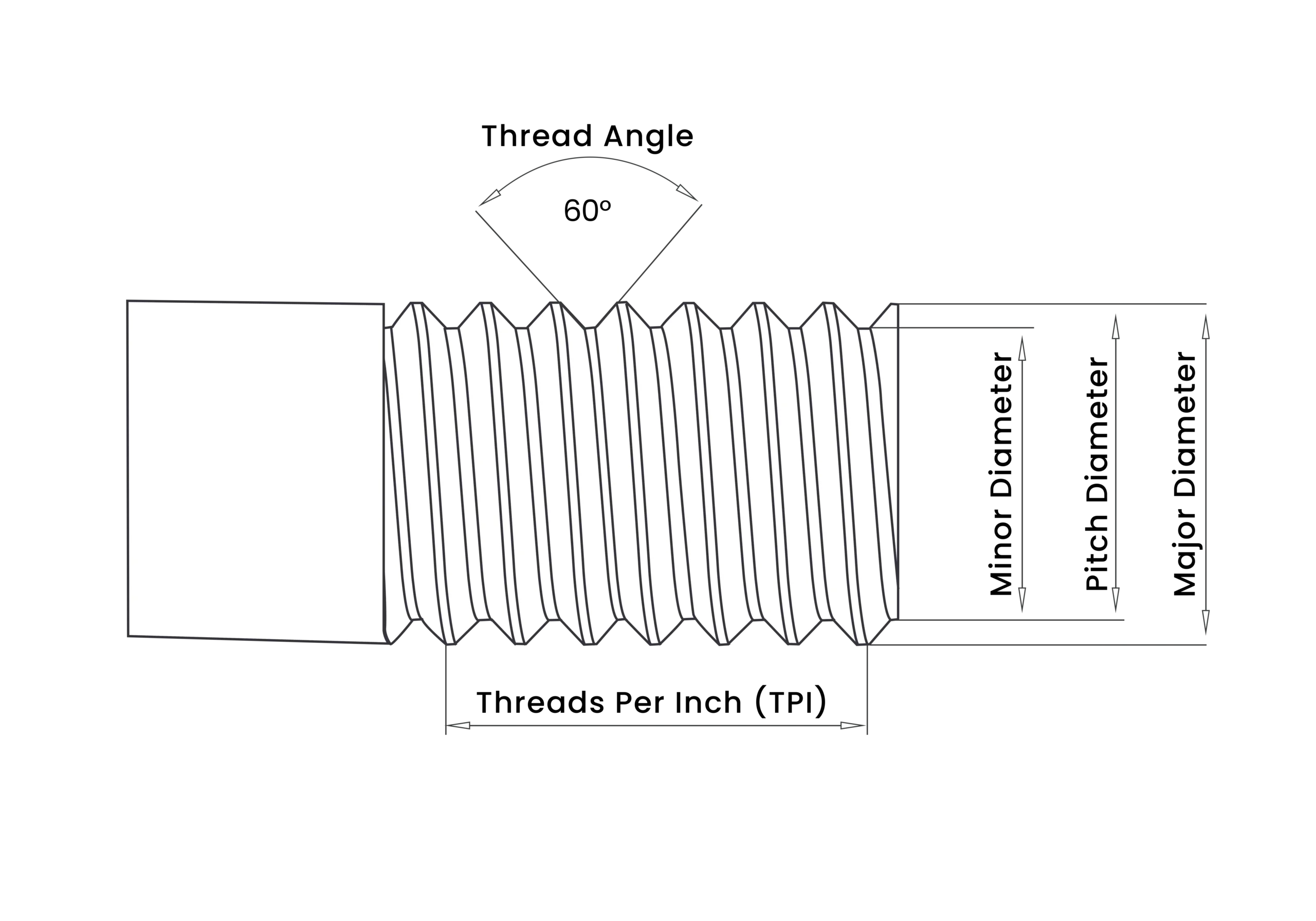
Major Diameter –
The largest diameter of the external thread, measured crest to crest.
This defines the nominal size of the screw or bolt.
Pitch Diameter –
The diameter of an imaginary cylinder where the thread thickness equals
the space between threads. This dimension primarily controls thread fit
and tolerance class of 2A and 3A.
Minor Diameter –
The smallest diameter of the external thread, measured root to root.
This affects thread strength and clearance.
Threads Per Inch (TPI) –
The number of complete threads within one inch of thread length.
Higher TPI values indicate a finer thread pitch.
For size 2-1/2, the nearest metric match is M64.
This particular size has a maximum major diameter of 63.968 mm (2.51843 inch),
which means the measurement offset is only about 0.468 mm (0.01843 inch).
While these diameters are nearly identical, metric and imperial fasteners are not interchangeable. They utilize fundamentally different thread systems: Imperial fasteners are measured by Threads Per Inch (TPI), whereas metric fasteners use Thread Pitch. Mixing metric and imperial hardware is strongly discouraged, as it can lead to damaged components, reduced load-bearing capacity, and catastrophic mechanical failure.
What is the difference between a bolt and a screw?
The difference is based on the intent of the fastener’s use; If the primary intent is for the fastener to pass through an unthreaded holes and be assembled with a nut, it is a Bolt. In this application, you usually hold the head and turn the nut to apply tension. But if the primary intent is for the fastener to be installed into a threaded (tapped) hole, it is a Screw. In this application, the connection is tightened by turning the head of the fastener itself.