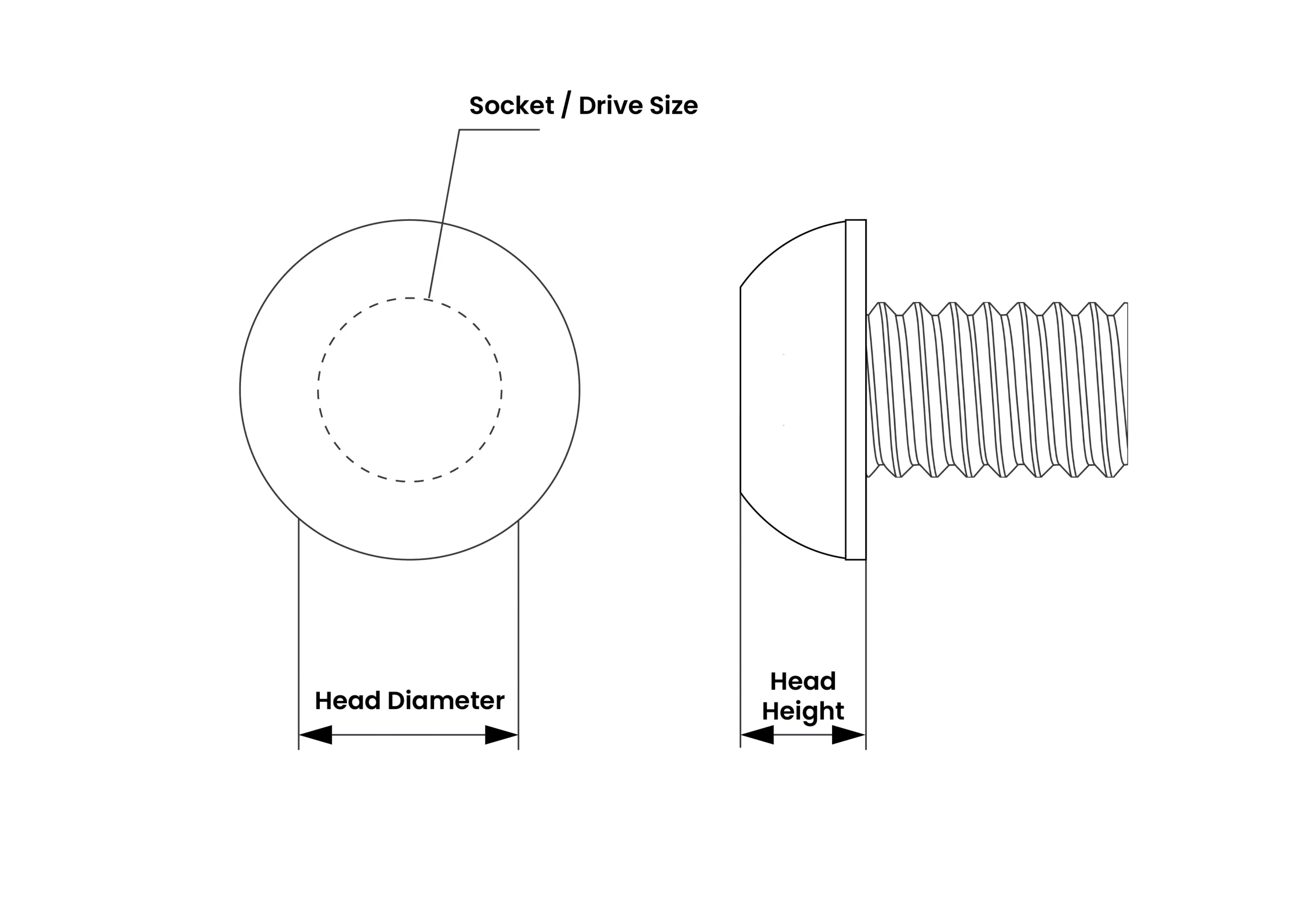
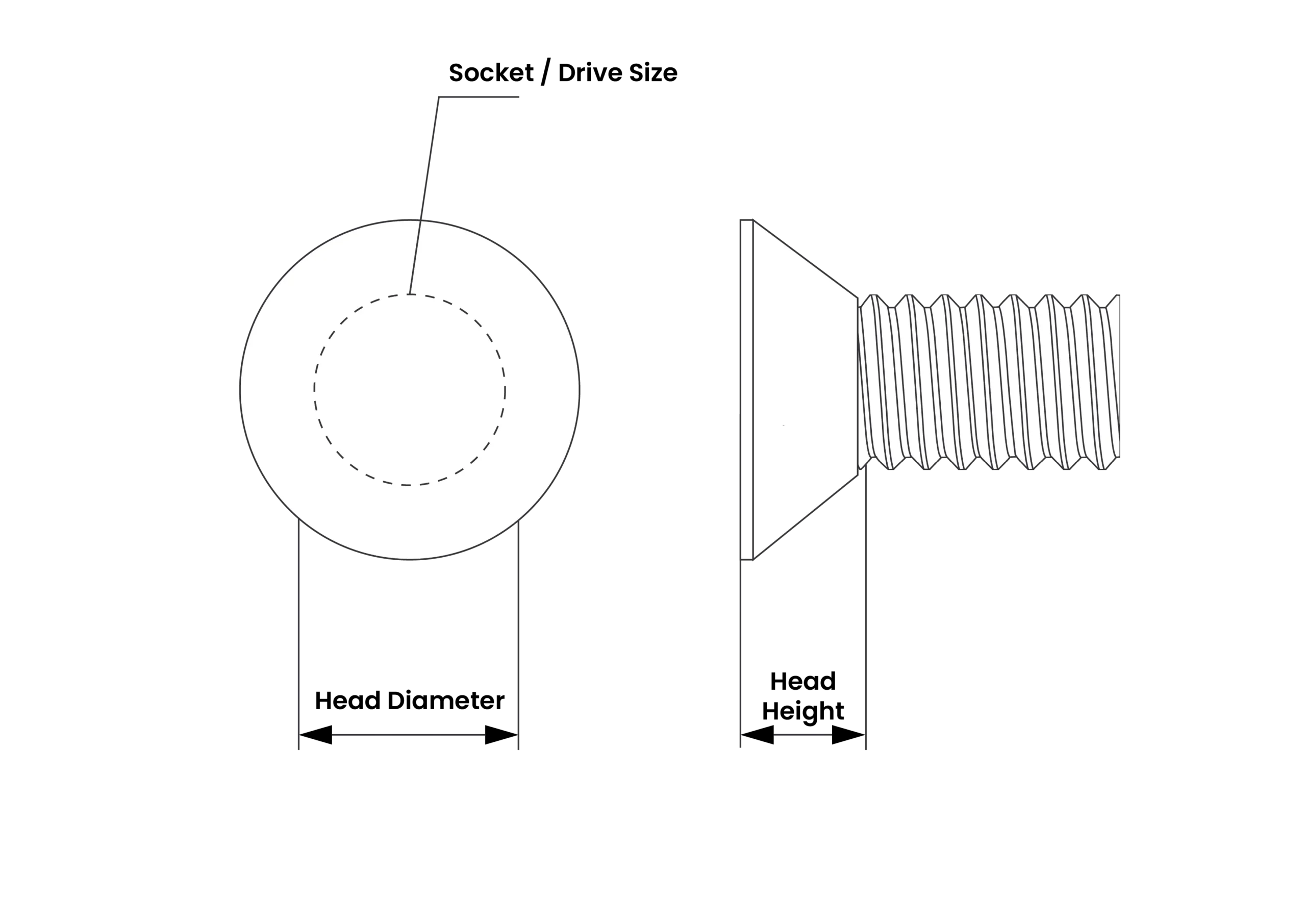
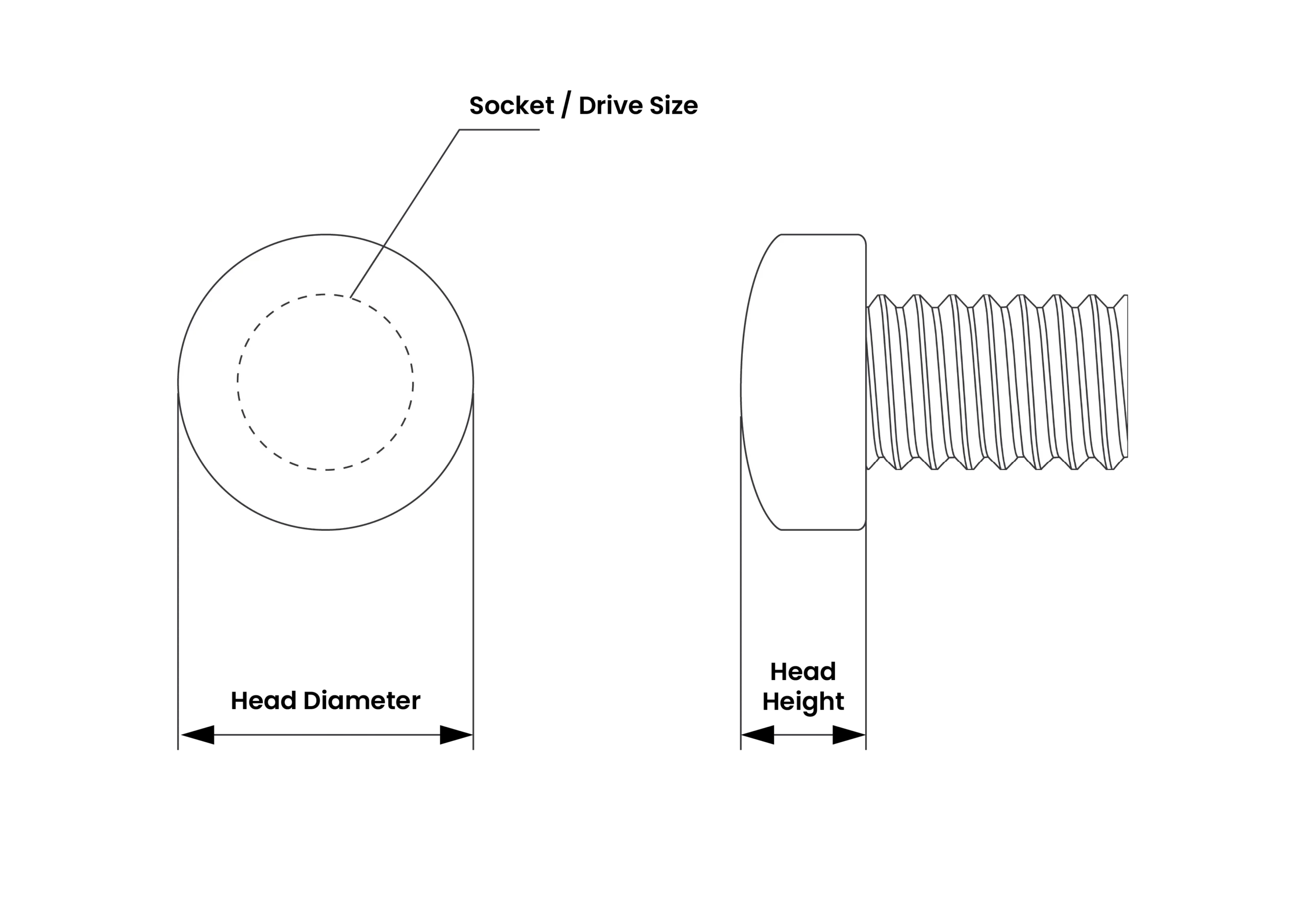
7/16” Screw & Bolt Dimensions: Diameter & Head Size
7/16″ bolt dimensions and screw sizes are essential for heavy automotive drivetrain components, industrial machinery, and medium-scale structural assemblies. This size have a 0.438″ nominal major diameter and is available in 7/16″-14 coarse (UNC), 7/16″-20 fine (UNF), or 7/16″-28 extra-fine (UNEF) thread pitches, representing 14, 20, and 28 threads per inch (TPI) respectively. This reference chart follows ANSI/ASME B18.6.3 and B18.3 standards for the head size and ANSI/ASME B1.1 standards for the thread dimensions to ensure compatibility across imperial fastening applications.
Disclaimer: Dimensions and tolerances may vary slightly depending on head style, manufacturer, or material — always verify with the official product datasheet before use.
7/16-14 UNC Screw & Bolt – ANSI/ASME B1.1
Dimension
Size (in)
Min
Max
Major Diameter
0.4206
0.4361
Pitch Diameter
0.3826
0.3897
Minor Diameter
Not specified
0.351
Threads Per Inch (TPI)
14
Major Diameter
0.4258
0.4361
Pitch Diameter
0.385
0.3897
Minor Diameter
Not specified
0.351
Threads Per Inch (TPI)
14
Major Diameter
0.4272
0.4375
Pitch Diameter
0.3876
0.3911
Minor Diameter
Not specified
0.3524
Threads Per Inch (TPI)
14
7/16-16 UN Screw & Bolt – ANSI/ASME B1.1
Dimension
Size (in)
Min
Max
Major Diameter
0.4267
0.4361
Pitch Diameter
0.3909
0.3955
Minor Diameter
Not specified
0.3617
Threads Per Inch (TPI)
16
Major Diameter
0.4281
0.4375
Pitch Diameter
0.3934
0.3969
Minor Diameter
Not specified
0.3631
Threads Per Inch (TPI)
16
7/16-20 UNF Screw & Bolt – ANSI/ASME B1.1
Dimension
Size (in)
Min
Max
Major Diameter
0.424
0.4362
Pitch Diameter
0.3974
0.4037
Minor Diameter
Not specified
0.3767
Threads Per Inch (TPI)
20
Major Diameter
0.4281
0.4362
Pitch Diameter
0.3995
0.4037
Minor Diameter
Not specified
0.3767
Threads Per Inch (TPI)
20
Major Diameter
0.4294
0.4375
Pitch Diameter
0.4019
0.405
Minor Diameter
Not specified
0.378
Threads Per Inch (TPI)
20
7/16-28 UNEF Screw & Bolt – ANSI/ASME B1.1
Dimension
Size (in)
Min
Max
Major Diameter
0.4299
0.4364
Pitch Diameter
0.4096
0.4132
Minor Diameter
Not specified
0.3939
Threads Per Inch (TPI)
28
Major Diameter
0.431
0.4375
Pitch Diameter
0.4116
0.4143
Minor Diameter
Not specified
0.395
Threads Per Inch (TPI)
28
7/16-32 UN Screw & Bolt – ANSI/ASME B1.1
Dimension
Size (in)
Min
Max
Major Diameter
0.4305
0.4365
Pitch Diameter
0.4128
0.4162
Minor Diameter
Not specified
0.3993
Threads Per Inch (TPI)
32
Major Diameter
0.4315
0.4375
Pitch Diameter
0.4146
0.4172
Minor Diameter
Not specified
0.4003
Threads Per Inch (TPI)
32
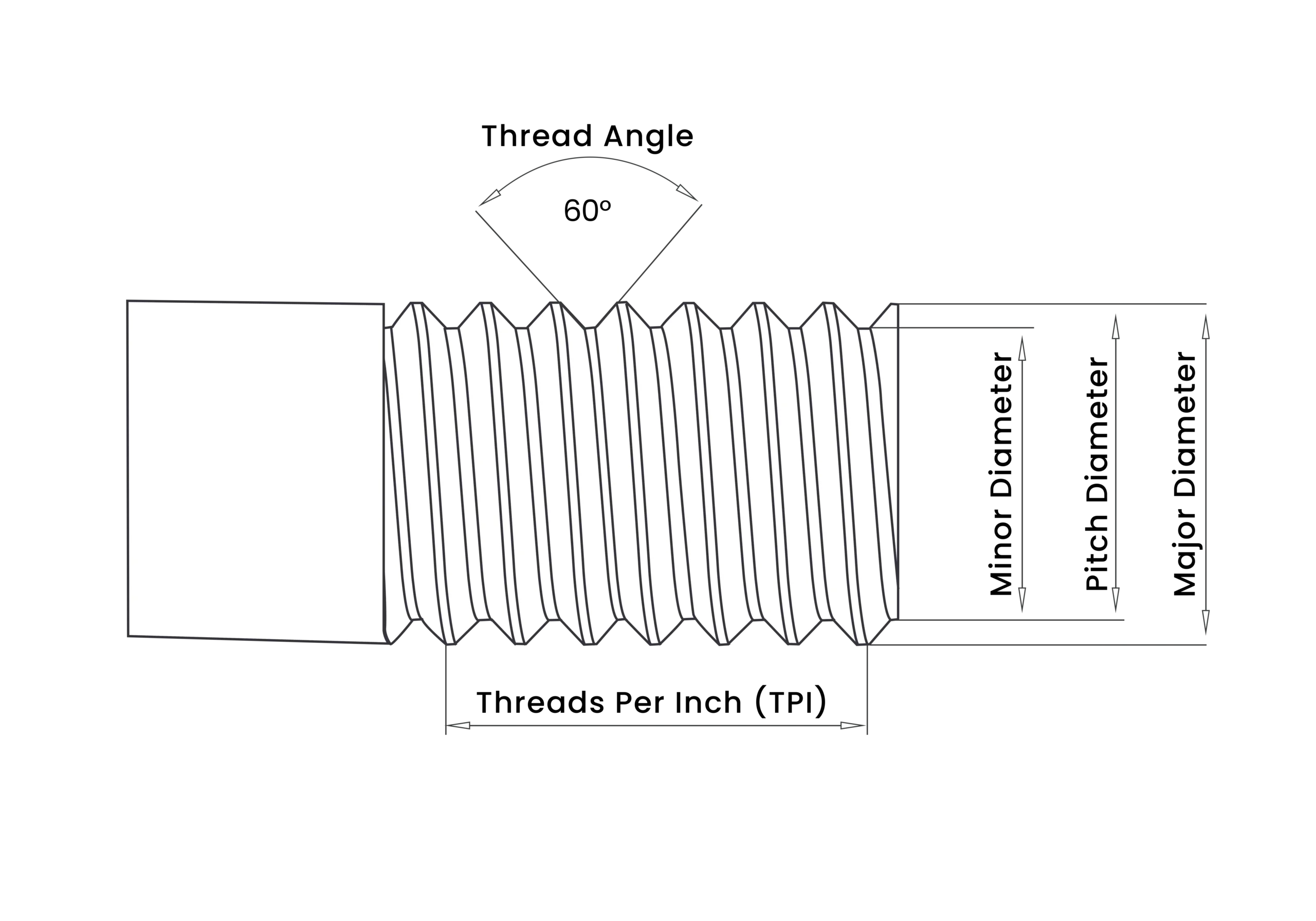
Major Diameter –
The largest diameter of the external thread, measured crest to crest.
This defines the nominal size of the screw or bolt.
Pitch Diameter –
The diameter of an imaginary cylinder where the thread thickness equals
the space between threads. This dimension primarily controls thread fit
and tolerance class of 2A and 3A.
Minor Diameter –
The smallest diameter of the external thread, measured root to root.
This affects thread strength and clearance.
Threads Per Inch (TPI) –
The number of complete threads within one inch of thread length.
Higher TPI values indicate a finer thread pitch.
What is the tap drill size for 7/16″-14, 7/16″-20, and 7/16″-28 screws or bolts?
The appropriate tap drill depends on the material and required thread engagement. For aluminum, brass, or plastic (75% thread), a U (0.368″) drill bit is specified for 7/16″-14, a 25/64″ (0.391″) for 7/16″-20, and a Y (0.404″) for 7/16″-28. For steel, stainless, or iron (50% thread), a 25/64″ (0.391″) drill bit is recommended for 7/16″-14, a 13/32″ (0.406″) for 7/16″-20, and a Z (0.413″) for 7/16″-28.
What clearance hole size is needed for a 7/16″ bolt or screw?
For a Close Fit, a 29/64″ (0.453″) drill bit is utilized. For a Normal/Free Fit (standard clearance), a 15/32″ (0.469″) drill bit is specified.
What is the equivalent size for 7/16 in metric?
For size 7/16, the nearest metric match is M11.
This particular size has a maximum major diameter of 10.978 mm (0.4322 inch),
which means the measurement offset is only about 0.134 mm (0.0053 inch).
While these diameters are nearly identical, metric and imperial fasteners are not interchangeable. They utilize fundamentally different thread systems: Imperial fasteners are measured by Threads Per Inch (TPI), whereas metric fasteners use Thread Pitch. Mixing metric and imperial hardware is strongly discouraged, as it can lead to damaged components, reduced load-bearing capacity, and catastrophic mechanical failure.
What is the difference between a bolt and a screw?
The difference is based on the intent of the fastener’s use; If the primary intent is for the fastener to pass through an unthreaded holes and be assembled with a nut, it is a Bolt. In this application, you usually hold the head and turn the nut to apply tension. But if the primary intent is for the fastener to be installed into a threaded (tapped) hole, it is a Screw. In this application, the connection is tightened by turning the head of the fastener itself.