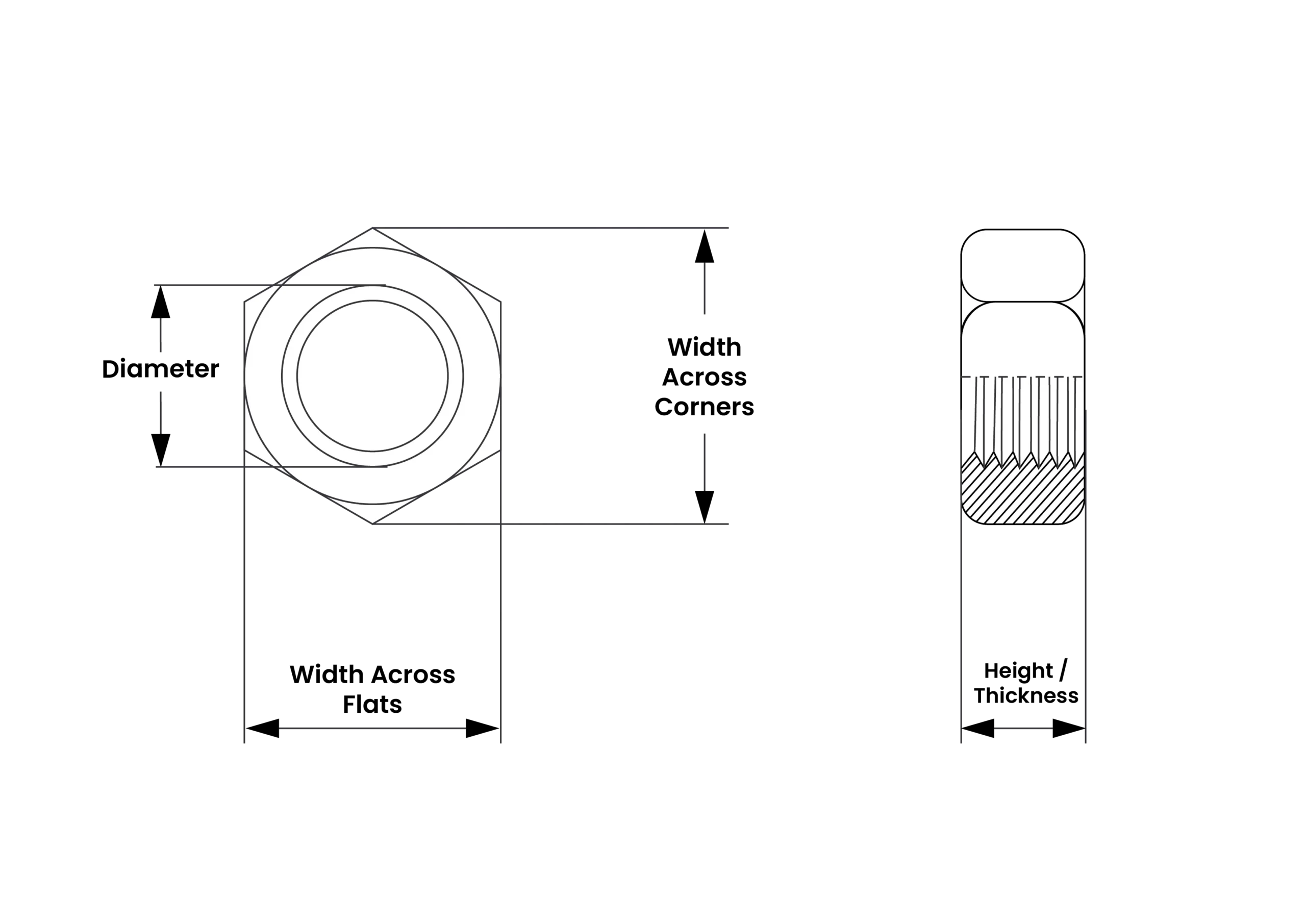
M56 nut dimensions or sizes are critical for wind turbine tower bases, high-rise structural anchoring, and heavy-duty maritime pier construction. This size is specifically engineered to mate with fasteners having a 56.00mm nominal diameter and is commonly available in M56 x 5.5 for the coarse series.
This charts is based on the Regular Series (DIN 934 / ISO 4032) for standard load-bearing applications and the Thin or Half Series (DIN 439 / ISO 4035), which is ideal for jam nut or lock nut configurations or applications with limited vertical clearance. The thread dimensions comply with DIN 13-1 (coarse) and ISO 68-1 standards to ensure a precise fit and reliable engagement across extreme-capacity metric fastening systems.
Disclaimer: Actual dimensions, including the width across flats (spanner or wrench size), nut height, and thread tolerance may vary depending on the specific manufacturing class and material — always verify with the official product datasheet before use or buying.
What size wrench or spanner do I need for an M56 nut?
An M56 hex nut typically requires an 85 mm wrench or socket. The standard width across flats (s) for an M56 nut is 85.00 mm. At this magnitude, traditional hand tools are insufficient; installation typically requires hydraulic bolt tensioning systems or high-ratio industrial torque multipliers.
What is a jam nut?
A jam nut is a low-profile hex nut, typically from the Thin Series (DIN 439), that is used to lock a standard nut in place. By tightening a standard nut against a jam nut, you create internal tension between the threads of both nuts and the bolt. This “jams” the assembly together, providing a mechanical lock that prevents loosening caused by extreme vibration or seismic activity.
Can a Thin Series nut handle the same torque as a Regular nut?
No. Because the Thin Series has significantly fewer threads in contact with the bolt, it has a lower proof load. For M56 fasteners, which are used in safety-critical structural foundations, using a thin nut as the primary fastener is highly dangerous as the threads are likely to strip or shear under the massive tension levels. Always use a Regular Series nut for primary load-bearing tasks.